
Author: ANIO OASIS ESSENTIALS LIMITED

  • Improve the Customer Journey by Fixing the Handoffs

    Websites and Conversion

    Improve the Customer Journey by Fixing the Handoffs

    Original practical guidance from ANIO OASIS ESSENTIALS. This article offers general advice, not a report of client work or guaranteed outcomes.
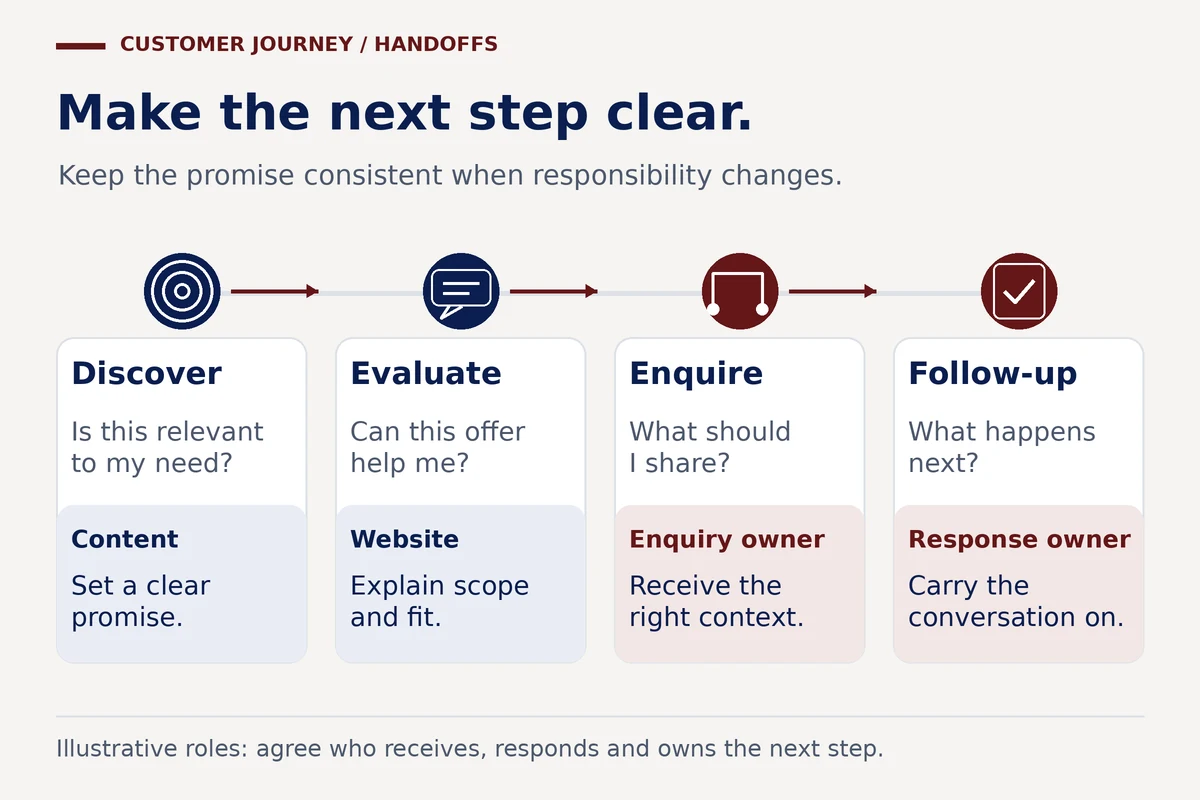
    Discover, evaluate, enquire and follow-up, with illustrative content, website, enquiry and response owners.
    Diagram reading guide
    1. Discover → Content: set a clear promise.
    2. Evaluate → Website: explain scope and fit.
    3. Enquire → Enquiry owner: receive the right context.
    4. Follow-up → Response owner: carry the conversation on.
    Illustrative responsibilities; agree actual owners in your team.

    Follow a task, not a channel list

    A customer journey is not simply a diagram of marketing channels. It is the sequence of questions and actions someone works through while deciding whether a business can help. The difficult moments often occur between touchpoints: an advertisement and its destination, a service page and an enquiry, or an enquiry and the next conversation.

    Choose one real customer task to examine. It might be understanding the scope of a service or deciding whether to request a discussion. Keep the exercise narrow enough to inspect closely. A detailed view of one important task is more actionable than a broad map built entirely from assumptions.

    Map questions and evidence

    For each stage, write down what the person is trying to establish. Early questions may concern the problem and possible approaches. Later questions may concern suitability, responsibilities, costs or next steps. Record the content or interaction that answers each question.

    Then label what is known and what needs validation. Existing customer questions and sales feedback can provide useful clues, but internal opinion is not a substitute for customer evidence. If an important concern has no clear answer, assign someone to clarify the information before adding another campaign to the journey.

    Inspect the promise at each transition

    Open the content in the order a visitor would encounter it. Does the landing page fulfil the promise made by the referring message? Is the language consistent? Can someone understand the offer without knowing the organisation's internal terminology? Does the next action explain what will happen?

    Check the practical experience as well as the copy. On a small screen, an important explanation may be difficult to find. A contact route may require unnecessary searching. A download may interrupt rather than help the decision. Remove friction that prevents a useful task, rather than adding decorative steps to make the journey look more elaborate.

    Design the human handover

    The journey does not end at a click. Agree who receives an enquiry, what information they need and how it reaches the person responsible for the next step. Avoid requesting details simply because they might be useful someday. Ask what is necessary to respond appropriately.

    Set realistic expectations in the public copy and internal process. Do not promise a response time the team has not agreed it can support. If email is the available route, provide a clear address and a short suggestion of what to include instead of displaying a form that does not work.

    Prioritise and verify improvements

    List the issues by customer impact, supporting evidence and effort to address. Start with broken or misleading transitions, then improve the information needed for decisions. A confusing service description may deserve attention before a new acquisition channel if interested visitors cannot establish whether the offering fits.

    After making a change, repeat the task and review relevant evidence. Check whether enquiries contain more useful context, whether visitors can reach the intended destination and whether staff can carry the conversation forward. Keep limitations visible and avoid assuming every improvement produces an immediate sales increase. The aim is a coherent journey in which each interaction makes the next decision easier.
  • Build a Marketing Measurement Plan That Helps You Decide

    Analytics

    Build a Marketing Measurement Plan That Helps You Decide

    Original practical guidance from ANIO OASIS ESSENTIALS. This article offers general advice, not a report of client work or guaranteed outcomes.

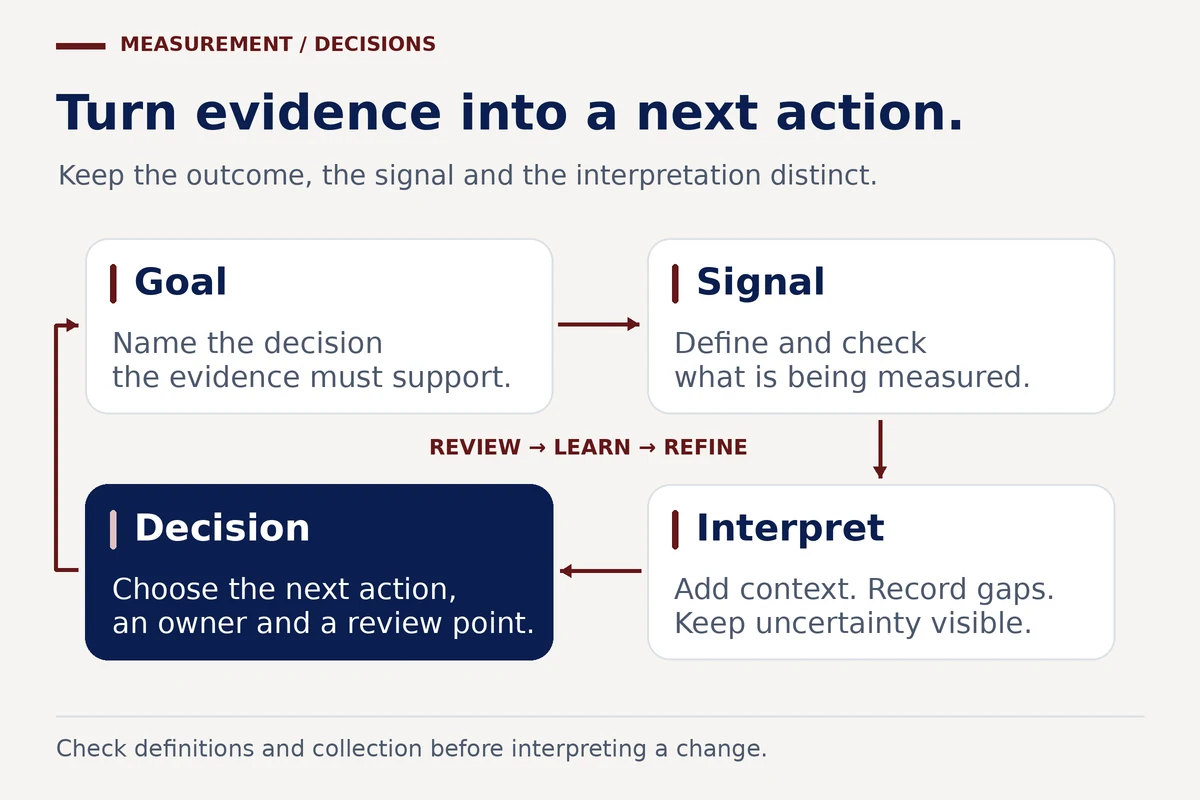
    A review loop links a business goal, checked signals, careful interpretation and an owned decision.
    Diagram reading guide
    1. Goal: name the decision the evidence must support.
    2. Signal: define and check what is being measured.
    3. Interpret: add context, record gaps and keep uncertainty visible.
    4. Decision: choose a next action, an owner and a review point.

    Begin with the decision, not the dashboard

    A dashboard is only useful if someone knows what decision it should support. Before collecting more metrics, identify the question: should a campaign continue, does a landing page need revision, or are enquiries reaching the right team? The question determines which evidence deserves attention.

    Choose a business outcome and a small set of supporting measures. For an enquiry-led business, submitted enquiries may be an intermediate measure, while qualified opportunities are closer to commercial value. Neither automatically explains why performance changed. Keep the outcome, the indicator and the interpretation distinct.

    Define what each measure means

    Create a short measurement dictionary. For every measure, record its definition, source, owner, reporting period and known limitations. An “enquiry” could mean an email click, a received message or an accepted sales opportunity. Those are different events and should not share an unexplained label.

    Agree how duplicates, spam, internal testing and incomplete records will be handled. Check whether the reporting period refers to the first interaction or a later sales stage. Consistent definitions make comparisons more useful and reduce arguments caused by teams looking at different versions of the same number.

    Check the collection before interpreting results

    If tracking is part of an agreed implementation, test the intended journey before relying on a report. Confirm that the event represents the action described, is not counted repeatedly and can be distinguished from internal testing. Record gaps rather than quietly treating missing data as zero.

    Collection choices also need appropriate privacy and consent review for the actual website and tools involved. A measurement plan is not permission to install every available tracker. Start with the information required for a legitimate business decision, then confirm how it can be collected and governed.

    Use comparisons with context

    A change in conversion rate can reflect a change in traffic mix, offer, seasonality or measurement, not only a better page. Compare like with like where possible and annotate changes that could affect interpretation. When the number of outcomes is small, describe the result cautiously rather than treating a short-term movement as a reliable pattern.

    Treat channel attribution as a model of the journey, not a complete account of causation. A recorded final interaction may follow earlier research or an offline conversation. Where feasible, connect marketing records with later sales information, but keep matching limitations and missing records visible.

    Turn the report into a next action

    Structure each review around four points: what happened, what might explain it, what remains uncertain and what to do next. An observation such as lower enquiry quality should lead to a specific investigation of targeting, message, offer or qualification, rather than an automatic increase in spending.

    Give the next action an owner and a review point. If testing a change, state the hypothesis and the primary measure before starting. Avoid changing several major variables and then claiming to know which one caused the result. Good measurement does not remove uncertainty; it makes uncertainty visible enough to guide a more responsible decision.

  • Choose Your Marketing Priority Before You Choose a Channel

    Strategy and Planning

    Choose Your Marketing Priority Before You Choose a Channel

    Original practical guidance from ANIO OASIS ESSENTIALS. This article offers general advice, not a report of client work or guaranteed outcomes.

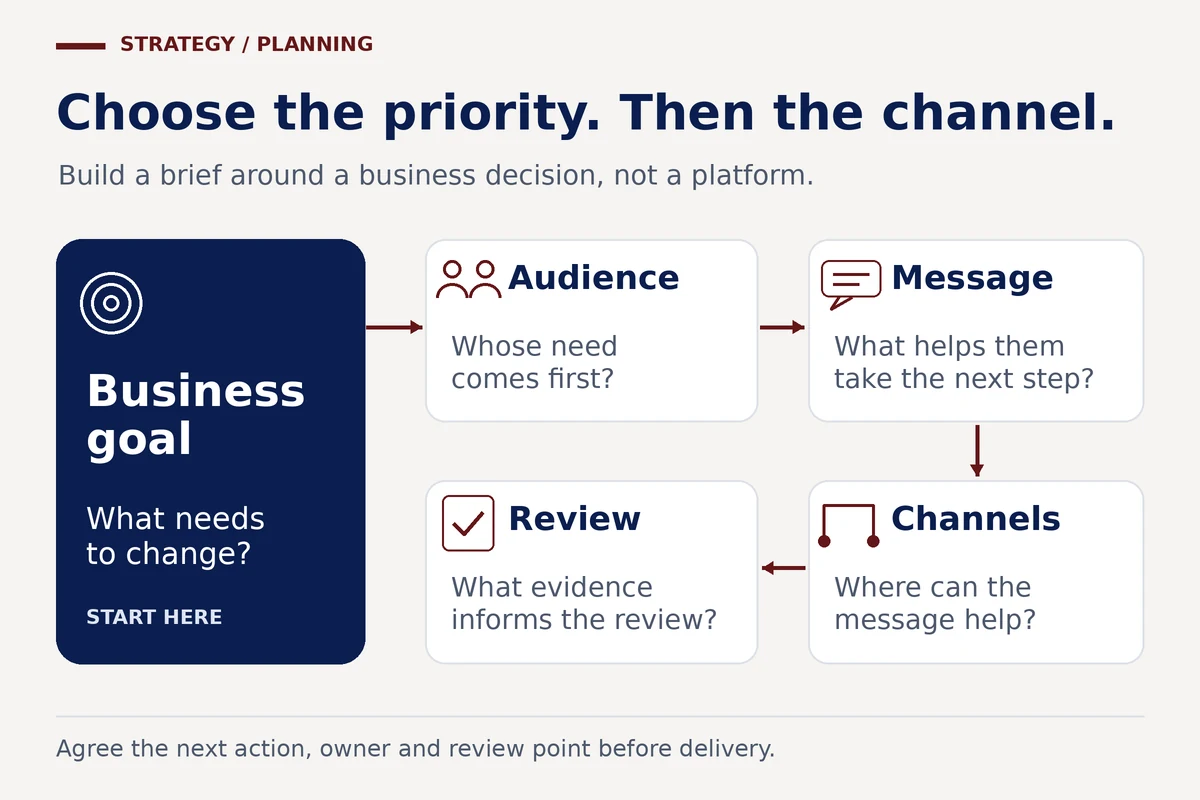
    Business goal leads to audience, message, channels and an evidence-led review.
    Diagram reading guide
    1. Business goal: what needs to change?
    2. Audience: whose need comes first?
    3. Message: what helps them take the next step?
    4. Channels: where can the message help?
    5. Review: what evidence informs the next decision?

    Start with a business decision

    A request to “do more marketing” is not yet a strategy. It leaves the team choosing activities before agreeing what those activities must change. A better starting point is a business decision: which audience, offer or stage of the buying journey deserves attention first? That question gives research and creative work a practical purpose.

    Write the objective in plain language. For example, a business might want more enquiries from organisations that need a particular service, rather than more website traffic in general. This is a hypothetical planning example, not a reported client result. The distinction matters because a busy channel can still attract people the business cannot serve.

    Find the constraint

    Before selecting a channel, examine where progress is currently limited. Are prospective customers unaware of the offer? Do they find the website but struggle to understand the difference? Do suitable enquiries stall because follow-up is unclear? Each situation calls for a different priority.

    Use the evidence already available: customer questions, sales conversations, enquiry quality and relevant website information. Separate observations from assumptions. “Customers often ask what is included” is an observation worth investigating. “A new social platform will fix demand” is an assumption that needs testing. If evidence is thin, choose a small research task before committing to a large programme.

    Define the audience and next action

    Describe a useful audience by its need and buying circumstances, not only its demographic profile. Identify the problem people are trying to solve, the alternatives they consider and the concerns that could prevent action. Then decide what a reasonable next step looks like.

    Someone researching a complex service may need an explanation before an enquiry invitation. Someone comparing suppliers may need scope, process and practical answers. Match the message and destination to that decision. A campaign promising one thing and a landing page discussing something else creates avoidable friction, regardless of the channel.

    Choose a focused combination

    Now compare possible channels against the objective, audience and available resources. Consider where people look for answers, what content is needed, how much delivery capacity exists and whether the business can handle the response. Include dependencies such as a clear landing page or an agreed sales handover.

    Avoid spreading a limited budget across every plausible activity. Build a focused combination with a defined role for each part. Search content might answer a specific question; a service page might explain the offer; an email conversation might establish fit. These are options to assess, not a universal prescription.

    Write the review decision in advance

    Finish with a short brief: objective, audience, offer, next action, channel role, owner and review point. Identify what evidence would support continuing, revising or stopping the work. Do not turn an early target into a promise of results.

    A useful review asks more than whether activity happened. Did the intended audience engage? Were the enquiries relevant? Could the business act on them? What remained uncertain? Agreeing those questions before launch helps the team learn without moving the goalposts. Strategy becomes a repeatable decision process rather than a document that is set aside once production begins.