
Analytics
Build a Marketing Measurement Plan That Helps You Decide
Original practical guidance from ANIO OASIS ESSENTIALS. This article offers general advice, not a report of client work or guaranteed outcomes.
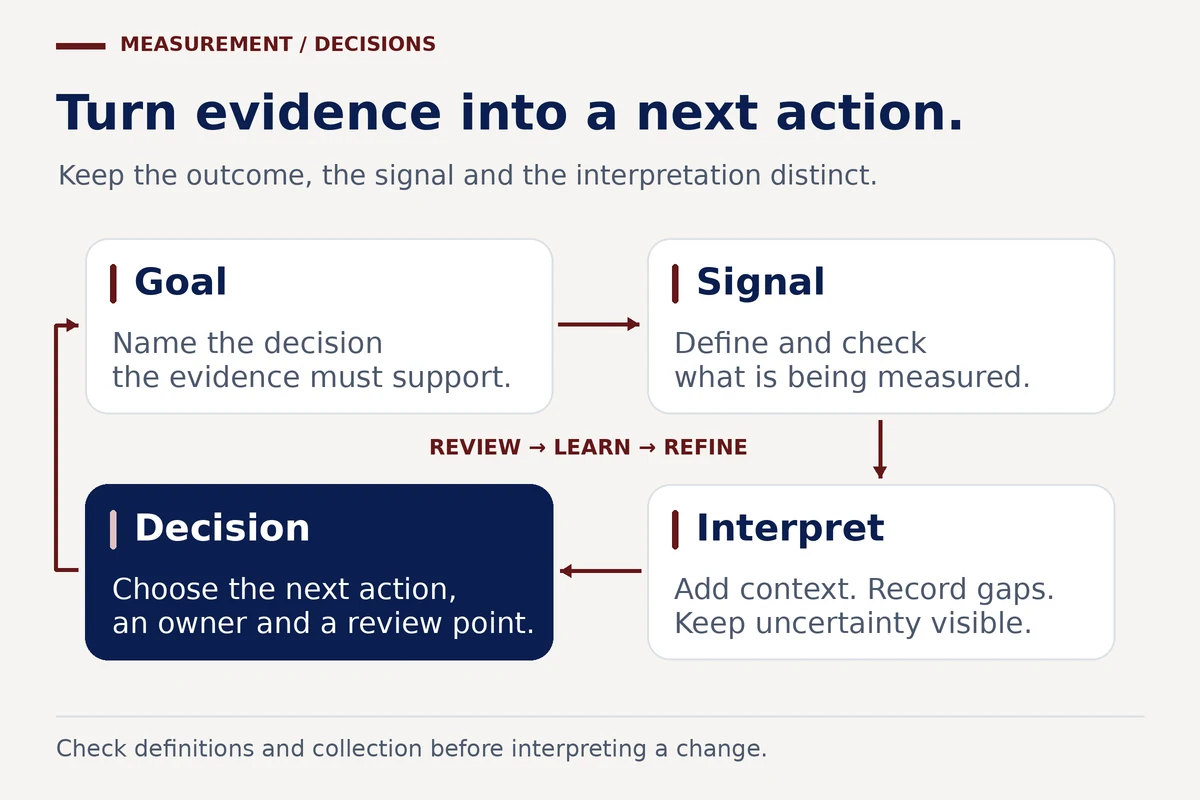
- Goal: name the decision the evidence must support.
- Signal: define and check what is being measured.
- Interpret: add context, record gaps and keep uncertainty visible.
- Decision: choose a next action, an owner and a review point.
Begin with the decision, not the dashboard
A dashboard is only useful if someone knows what decision it should support. Before collecting more metrics, identify the question: should a campaign continue, does a landing page need revision, or are enquiries reaching the right team? The question determines which evidence deserves attention.
Choose a business outcome and a small set of supporting measures. For an enquiry-led business, submitted enquiries may be an intermediate measure, while qualified opportunities are closer to commercial value. Neither automatically explains why performance changed. Keep the outcome, the indicator and the interpretation distinct.
Define what each measure means
Create a short measurement dictionary. For every measure, record its definition, source, owner, reporting period and known limitations. An “enquiry” could mean an email click, a received message or an accepted sales opportunity. Those are different events and should not share an unexplained label.
Agree how duplicates, spam, internal testing and incomplete records will be handled. Check whether the reporting period refers to the first interaction or a later sales stage. Consistent definitions make comparisons more useful and reduce arguments caused by teams looking at different versions of the same number.
Check the collection before interpreting results
If tracking is part of an agreed implementation, test the intended journey before relying on a report. Confirm that the event represents the action described, is not counted repeatedly and can be distinguished from internal testing. Record gaps rather than quietly treating missing data as zero.
Collection choices also need appropriate privacy and consent review for the actual website and tools involved. A measurement plan is not permission to install every available tracker. Start with the information required for a legitimate business decision, then confirm how it can be collected and governed.
Use comparisons with context
A change in conversion rate can reflect a change in traffic mix, offer, seasonality or measurement, not only a better page. Compare like with like where possible and annotate changes that could affect interpretation. When the number of outcomes is small, describe the result cautiously rather than treating a short-term movement as a reliable pattern.
Treat channel attribution as a model of the journey, not a complete account of causation. A recorded final interaction may follow earlier research or an offline conversation. Where feasible, connect marketing records with later sales information, but keep matching limitations and missing records visible.
Turn the report into a next action
Structure each review around four points: what happened, what might explain it, what remains uncertain and what to do next. An observation such as lower enquiry quality should lead to a specific investigation of targeting, message, offer or qualification, rather than an automatic increase in spending.
Give the next action an owner and a review point. If testing a change, state the hypothesis and the primary measure before starting. Avoid changing several major variables and then claiming to know which one caused the result. Good measurement does not remove uncertainty; it makes uncertainty visible enough to guide a more responsible decision.
Leave a Reply