
Websites and Conversion
Improve the Customer Journey by Fixing the Handoffs
Original practical guidance from ANIO OASIS ESSENTIALS. This article offers general advice, not a report of client work or guaranteed outcomes.
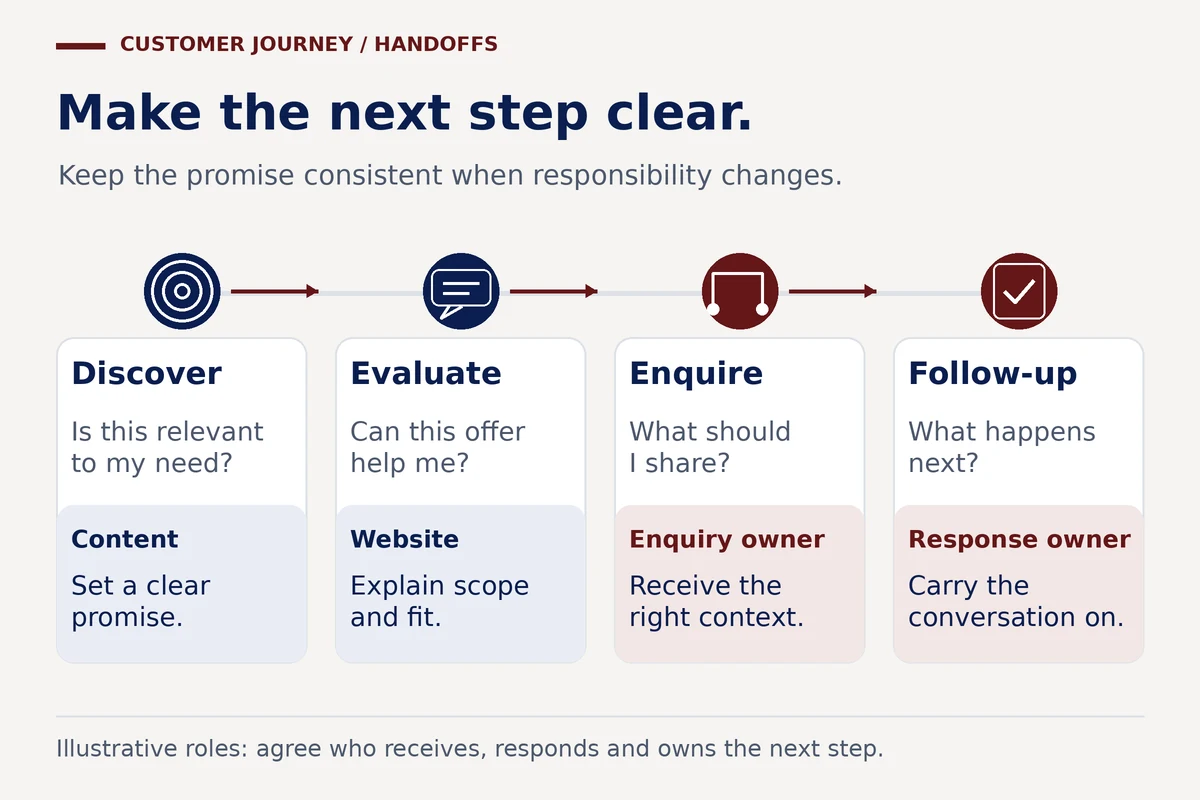
- Discover → Content: set a clear promise.
- Evaluate → Website: explain scope and fit.
- Enquire → Enquiry owner: receive the right context.
- Follow-up → Response owner: carry the conversation on.
Follow a task, not a channel list
A customer journey is not simply a diagram of marketing channels. It is the sequence of questions and actions someone works through while deciding whether a business can help. The difficult moments often occur between touchpoints: an advertisement and its destination, a service page and an enquiry, or an enquiry and the next conversation.
Choose one real customer task to examine. It might be understanding the scope of a service or deciding whether to request a discussion. Keep the exercise narrow enough to inspect closely. A detailed view of one important task is more actionable than a broad map built entirely from assumptions.
Map questions and evidence
For each stage, write down what the person is trying to establish. Early questions may concern the problem and possible approaches. Later questions may concern suitability, responsibilities, costs or next steps. Record the content or interaction that answers each question.
Then label what is known and what needs validation. Existing customer questions and sales feedback can provide useful clues, but internal opinion is not a substitute for customer evidence. If an important concern has no clear answer, assign someone to clarify the information before adding another campaign to the journey.
Inspect the promise at each transition
Open the content in the order a visitor would encounter it. Does the landing page fulfil the promise made by the referring message? Is the language consistent? Can someone understand the offer without knowing the organisation's internal terminology? Does the next action explain what will happen?
Check the practical experience as well as the copy. On a small screen, an important explanation may be difficult to find. A contact route may require unnecessary searching. A download may interrupt rather than help the decision. Remove friction that prevents a useful task, rather than adding decorative steps to make the journey look more elaborate.
Design the human handover
The journey does not end at a click. Agree who receives an enquiry, what information they need and how it reaches the person responsible for the next step. Avoid requesting details simply because they might be useful someday. Ask what is necessary to respond appropriately.
Set realistic expectations in the public copy and internal process. Do not promise a response time the team has not agreed it can support. If email is the available route, provide a clear address and a short suggestion of what to include instead of displaying a form that does not work.
Prioritise and verify improvements
List the issues by customer impact, supporting evidence and effort to address. Start with broken or misleading transitions, then improve the information needed for decisions. A confusing service description may deserve attention before a new acquisition channel if interested visitors cannot establish whether the offering fits.
After making a change, repeat the task and review relevant evidence. Check whether enquiries contain more useful context, whether visitors can reach the intended destination and whether staff can carry the conversation forward. Keep limitations visible and avoid assuming every improvement produces an immediate sales increase. The aim is a coherent journey in which each interaction makes the next decision easier.
Leave a Reply