
Strategy and Planning
Choose Your Marketing Priority Before You Choose a Channel
Original practical guidance from ANIO OASIS ESSENTIALS. This article offers general advice, not a report of client work or guaranteed outcomes.
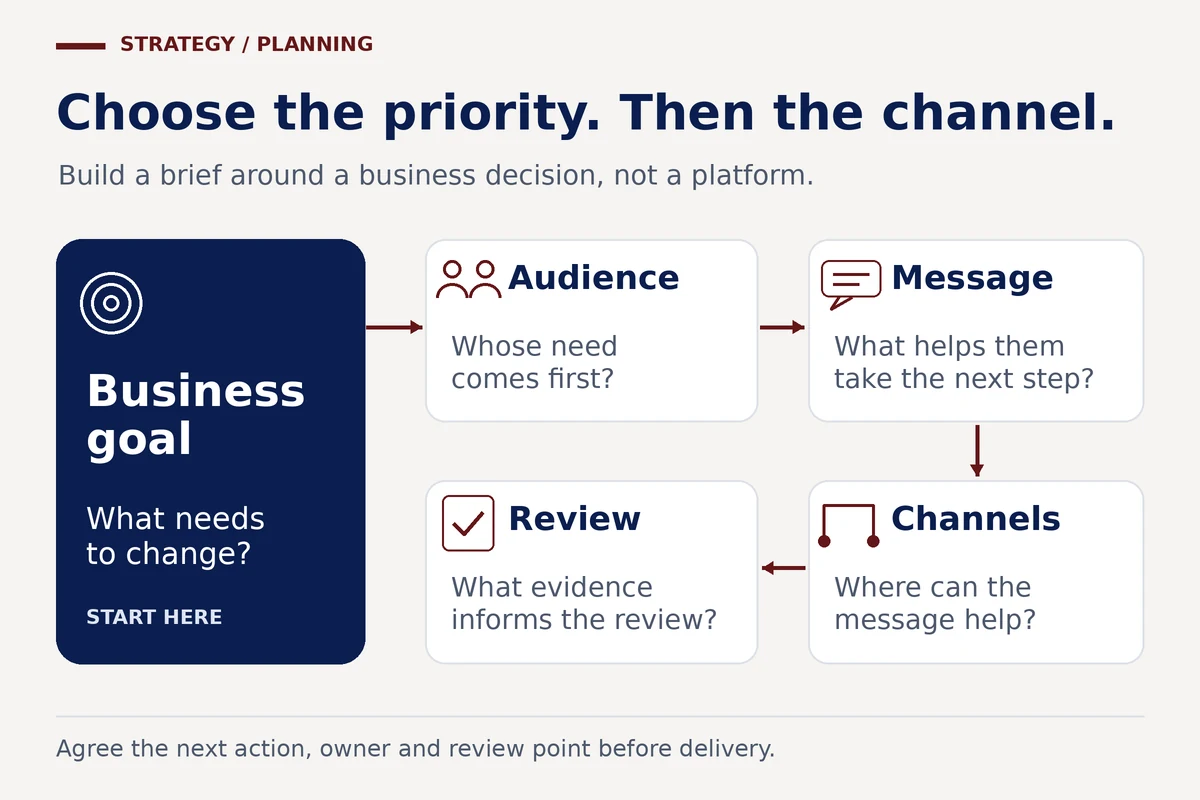
- Business goal: what needs to change?
- Audience: whose need comes first?
- Message: what helps them take the next step?
- Channels: where can the message help?
- Review: what evidence informs the next decision?
Start with a business decision
A request to “do more marketing” is not yet a strategy. It leaves the team choosing activities before agreeing what those activities must change. A better starting point is a business decision: which audience, offer or stage of the buying journey deserves attention first? That question gives research and creative work a practical purpose.
Write the objective in plain language. For example, a business might want more enquiries from organisations that need a particular service, rather than more website traffic in general. This is a hypothetical planning example, not a reported client result. The distinction matters because a busy channel can still attract people the business cannot serve.
Find the constraint
Before selecting a channel, examine where progress is currently limited. Are prospective customers unaware of the offer? Do they find the website but struggle to understand the difference? Do suitable enquiries stall because follow-up is unclear? Each situation calls for a different priority.
Use the evidence already available: customer questions, sales conversations, enquiry quality and relevant website information. Separate observations from assumptions. “Customers often ask what is included” is an observation worth investigating. “A new social platform will fix demand” is an assumption that needs testing. If evidence is thin, choose a small research task before committing to a large programme.
Define the audience and next action
Describe a useful audience by its need and buying circumstances, not only its demographic profile. Identify the problem people are trying to solve, the alternatives they consider and the concerns that could prevent action. Then decide what a reasonable next step looks like.
Someone researching a complex service may need an explanation before an enquiry invitation. Someone comparing suppliers may need scope, process and practical answers. Match the message and destination to that decision. A campaign promising one thing and a landing page discussing something else creates avoidable friction, regardless of the channel.
Choose a focused combination
Now compare possible channels against the objective, audience and available resources. Consider where people look for answers, what content is needed, how much delivery capacity exists and whether the business can handle the response. Include dependencies such as a clear landing page or an agreed sales handover.
Avoid spreading a limited budget across every plausible activity. Build a focused combination with a defined role for each part. Search content might answer a specific question; a service page might explain the offer; an email conversation might establish fit. These are options to assess, not a universal prescription.
Write the review decision in advance
Finish with a short brief: objective, audience, offer, next action, channel role, owner and review point. Identify what evidence would support continuing, revising or stopping the work. Do not turn an early target into a promise of results.
A useful review asks more than whether activity happened. Did the intended audience engage? Were the enquiries relevant? Could the business act on them? What remained uncertain? Agreeing those questions before launch helps the team learn without moving the goalposts. Strategy becomes a repeatable decision process rather than a document that is set aside once production begins.
Leave a Reply